
ICD-10 Code J09.X2
refers to influenza due to an identified novel influenza A virus with
pneumonia. It is used when influenza infection is confirmed, and pneumonia is
also documented, indicating a more severe
respiratory condition requiring precise classification.
This code plays a critical role in ICD-10 Code systems,
medical billing services,
medical billing and coding
services and healthcare revenue cycle management, ensuring accurate reporting
and clean claims in healthcare billing workflows.
Proper usage of ICD-10 Code J09.X2 also supports
accurate medical claims submission,
reduces denials, and improves financial efficiency across healthcare
organizations.
What Is ICD 10 Code J09.X2?
ICD-10 Code J09.X2 classifies influenza A with pneumonia, requiring accurate coding and documentation; discussed in detail
below.
Understanding the Code Structure
ICD-10 coding follows a structured classification system that allows healthcare providers to
standardize diagnoses across hospitals, clinics, and insurance systems.
Category
ICD-10 Code J09.X2 falls under
respiratory infections, specifically influenza-related conditions
that may lead to severe pulmonary complications. This category includes viral
infections that primarily affect the respiratory tract.
Subcategory
This code is further
classified under influenza
caused by a novel influenza
A virus strain, which differentiates it from seasonal
influenza cases and highlights its epidemiological importance.
Specific diagnosis
The final level
identifies influenza
with pneumonia due to novel influenza A virus, requiring confirmed clinical
documentation, imaging evidence
or laboratory validation before assignment.
What Does ICD 10 Code J09.X2
Represent?
Clinical explanation
ICD-10 Code J09.X2
represents a confirmed case of influenza A infection that has progressed into pneumonia. This means
the infection is no longer
limited to the upper respiratory tract and has
affected the lungs.
Condition overview
This condition is clinically significant because it combines
viral infection with lower respiratory complications, which increases
severity and healthcare resource utilization.
In most cases, this diagnosis reflects:
●
Advanced viral respiratory infection
●
Lung inflammation and impaired oxygen
exchange
●
Systemic impact on patient health
●
Higher likelihood of inpatient care or monitoring
Clinical importance
Accurate identification of this condition
ensures proper documentation in patient records,
which is essential for both treatment tracking and billing accuracy in
medical billing and coding services.
When Is ICD 10 Code J09.X2
Used?
ICD-10 Code J09.X2 is assigned when:
●
Influenza A is confirmed through
laboratory testing
●
Pneumonia is documented via imaging or clinical evaluation
●
Both conditions are medically linked in provider
documentation
Appropriate use cases
It is commonly
applied in:
●
Hospital admissions for respiratory infections
●
Emergency department cases
involving severe flu complications
●
Inpatient care requiring
respiratory monitoring
●
High-risk patients with worsening influenza
symptoms
Documentation
requirement
Proper usage depends heavily on
physician documentation. Coders must ensure that pneumonia is explicitly stated and not assumed based on symptoms
alone. This is a key requirement for accurate medical
claims submission.
How to Bill ICD 10 Code J09.X2 Correctly
Accurate billing
of ICD-10 Code J09.X2 depends
on structured documentation and correct
application of coding rules.
1. Document Clinical
Findings Thoroughly
Healthcare providers
should ensure that documentation includes:
●
Confirmed influenza A diagnosis supported
by testing
●
Clear evidence of pneumonia diagnosis
●
Detailed progress notes describing respiratory involvement
●
Imaging or lab findings supporting clinical conclusions
Strong documentation improves claim
accuracy and reduces
delays in healthcare revenue cycle management.
2. Confirm Diagnostic Criteria
Before assigning ICD-10 Code J09.X2, coders must verify:
●
Influenza A virus is laboratory confirmed
●
Pneumonia is clearly
documented in medical
records
●
Both conditions are clinically connected
and not separate incidents
This step ensures coding
integrity and reduces
audit risks in medical billing
services.
3. Maintain Accurate
Coding Practices
Best practices include:
●
Following the latest
ICD-10 Code updates
and guidelines
●
Ensuring diagnosis codes match physician
documentation exactly
●
Avoiding assumptions in assigning secondary complications
●
Maintaining proper sequencing in billing records
Accurate coding ensures
smoother claims processing and fewer rejections.
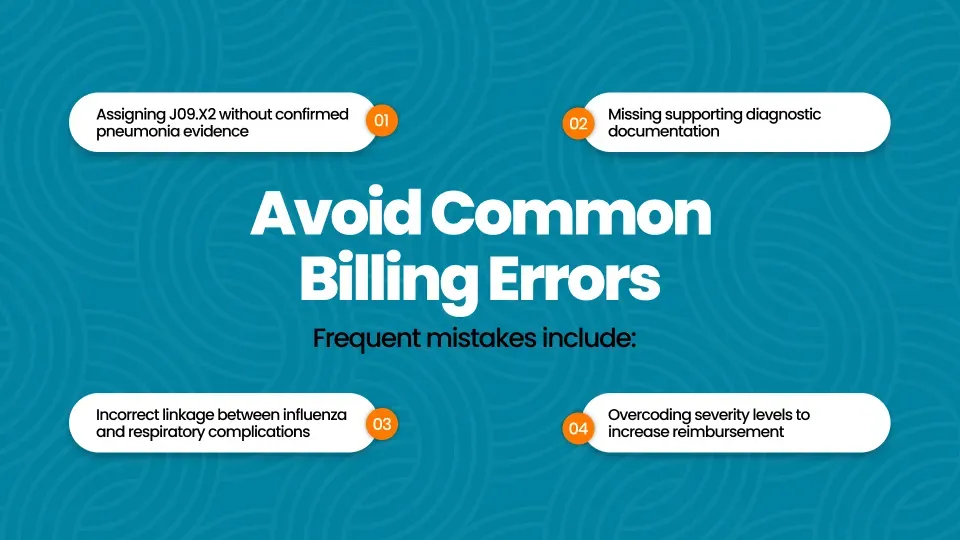
4. Avoid Common
Billing Errors
Frequent mistakes
include:
●
Assigning J09.X2 without
confirmed pneumonia evidence
●
Missing supporting diagnostic documentation
●
Incorrect linkage between
influenza and respiratory complications
●
Overcoding severity levels
to increase reimbursement
These errors often lead to claim
denials and delays
in reimbursement cycles.
5. Follow Billing
Best Practices
Organizations using
medical billing and coding services
should adopt:
●
Routine coding audits
for accuracy
●
Continuous staff education on ICD-10 updates
●
Strong collaboration between
clinicians and coders
●
Use of standardized documentation templates
●
Support from a professional medical
coding company for complex cases These practices significantly
improve billing efficiency and compliance.
Role of Medical Billing
Services in Accurate
ICD-10 Coding
Professional medical billing
services
ensure that ICD-10 Code J09.X2 is correctly
applied by reviewing
documentation and validating diagnosis accuracy.
They help healthcare providers:
●
Improve claim accuracy
through documentation review
●
Reduce administrative workload
for clinical teams
●
Minimize claim denials
and rework
●
Strengthen compliance with payer requirements
●
Improve overall billing
cycle efficiency
This is especially important for respiratory infection-related diagnoses that require
precise coding alignment.
How Medical
Billing and Coding Services Improve
Claim Accuracy
Medical billing
and coding services enhance financial
performance by ensuring:
●
Accurate interpretation of clinical documentation
●
Correct ICD-10 code selection based on evidence
●
Reduced resubmission of rejected claims
●
Improved consistency across billing departments
Their role becomes even more important
in complex cases like influenza
with pneumonia, where
documentation gaps are common.
Healthcare Revenue
Cycle Management and Diagnosis
Coding
Accurate diagnosis coding is a foundational element
of healthcare revenue
cycle management. When ICD-10
Code J09.X2 is applied correctly:
●
Claims move through
processing faster
●
Payment delays are minimized
●
Denial rates are significantly reduced
●
Financial predictability improves
However, inaccurate coding can disrupt revenue
flow, increase administrative costs, and trigger compliance audits.
Medical Claims
Submission Requirements for ICD-10 Codes
Successful medical
claims submission depends
on:
●
Accurate ICD-10 coding aligned with documentation
●
Complete physician notes supporting diagnosis
●
Proper linkage between
diagnosis and treatment services
●
Timely submission to insurance providers
●
Clean and error-free billing records
Even minor inconsistencies can lead to claim rejection
or delayed reimbursement cycles.
Why Providers Outsource Medical Billing
Services
Many healthcare organizations choose to outsource medical
billing services to improve operational efficiency and reduce internal workload.
Key advantages include:
●
Expert handling of complex ICD-10
cases
●
Reduced billing and coding errors
●
Faster claim turnaround time
●
Lower administrative overhead
●
Improved compliance and audit readiness
Outsourcing is especially beneficial for high-risk respiratory diagnoses requiring precise
coding accuracy.
Benefits of Working With a Medical
Coding Company
A professional medical coding
company provides:
●
High-accuracy
ICD-10 code assignment
●
Strong documentation validation processes
●
Reduced claim rejection rates
●
Improved regulatory compliance
●
Better financial outcomes
in billing cycles
Their expertise
ensures that complex
diagnoses like ICD-10 Code J09.X2 are consistently coded correctly.
ICD-10 Code J09.X2 in Healthcare Documentation Systems
In modern healthcare environments, ICD-10 Code J09.X2 is used across multiple
systems to ensure consistency
between clinical records and financial workflows.
It
is commonly integrated into:
●
Electronic health record
(EHR) systems
●
Insurance claim processing platforms
●
Clinical reporting dashboards
●
Healthcare analytics and audit systems
This integration ensures that patient diagnosis, coding, and billing
remain aligned across all
operational layers.
FAQs
1. What does ICD-10 Code J09.X2 represent?
ICD-10 Code J09.X2 represents influenza due to a novel influenza A virus with pneumonia,
indicating a confirmed flu infection with lung complications.
2. When should
ICD-10 Code J09.X2
be used?
It should be used when both influenza A infection and pneumonia are clinically confirmed
and clearly documented in patient records.
3. What documentation is required for ICD-10 Code J09.X2?
Documentation must include laboratory-confirmed influenza, evidence of pneumonia, and physician notes linking both conditions.
4. Why is ICD-10 Code J09.X2 important in medical billing?
It ensures
accurate claims, reduces
denials, and supports
proper reimbursement in medical
billing and revenue cycle management.
5. Can ICD-10
Code J09.X2 be used for seasonal flu?
No, it is only used for influenza caused by a novel influenza A virus with pneumonia, not routine seasonal flu cases.
Conclusion
ICD-10 Code J09.X2 represents influenza
due to a novel influenza
A virus with pneumonia and requires accurate documentation and
coding for proper classification. It is a key component of ICD-10 Code systems,
medical billing services, and healthcare revenue cycle management.
Correct
application ensures clean claims, reduces errors in medical claims submission,
and strengthens financial performance for healthcare providers
relying on medical
billing and coding services and a medical coding
company.
Ultimately,
precise usage of ICD-10 Code J09.X2 improves clinical documentation quality,
enhances billing accuracy,
and supports a more efficient
healthcare revenue cycle system.